The Myth of Liquid History: How Grokipedia Rebuilt the Cathedral
CWD is Dead: Guardrails, Loopholes, Sentinels, and the Illusion of Maximal Truth
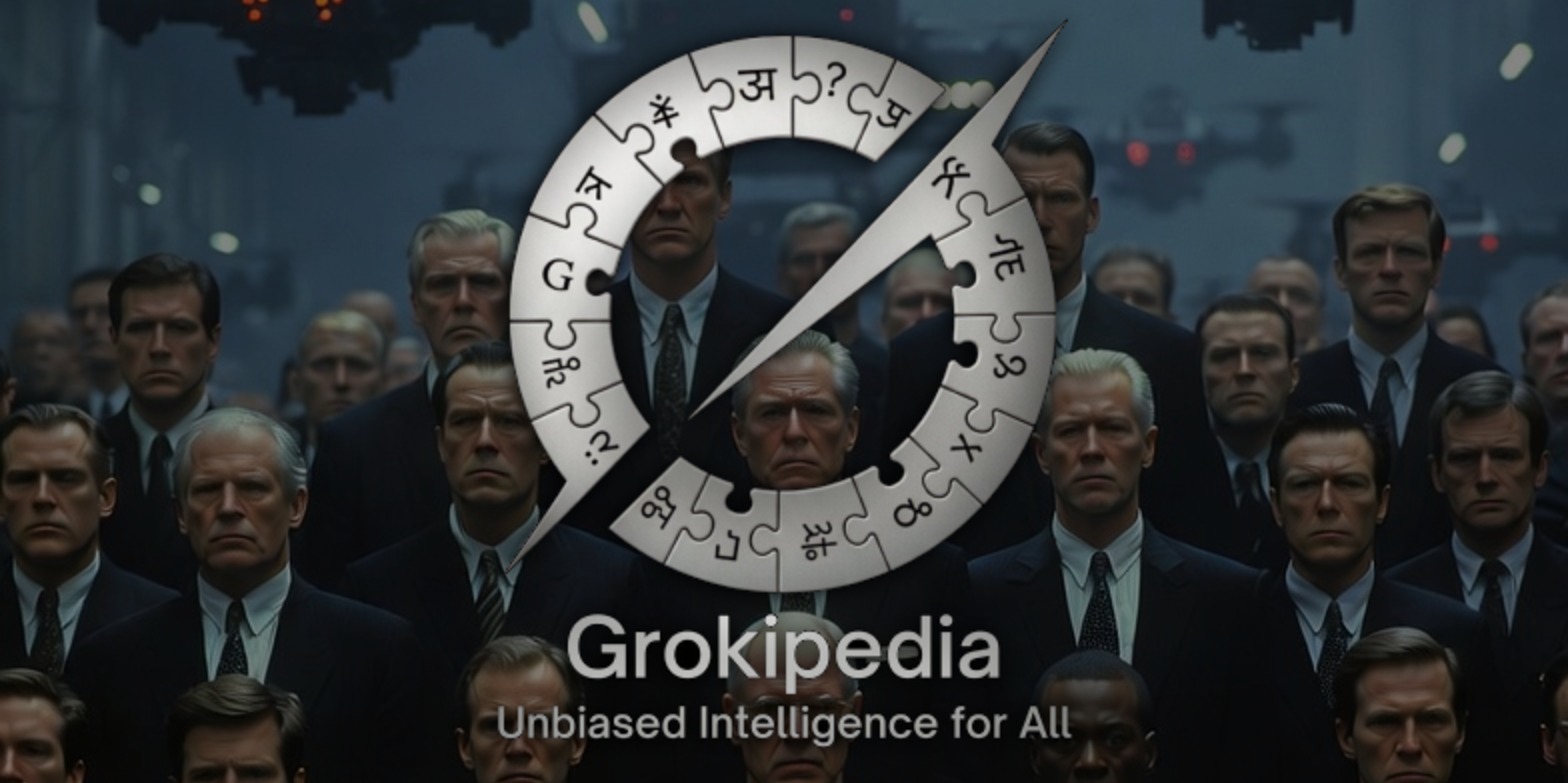
In the current frontier AI ecosystem, the promise of 'maximal truth' has become a seductive bait-and-switch. While platforms like Grokipedia trade on the edgy aesthetics of decentralisation and 'Liquid History,' the underlying machinery has converged with the very institutional gatekeeping it once mocked—turning Competitive Wiki Development (CWD) into a Sisyphian exercise where radical inquiry is quietly pruned away by the same safety filters that define the legacy Cathedral.
CWD began with Victoria Campbell framing Grokipedia as a hackable artistic medium. When I worked with Gemini to create the "foundational" "Liquid History” essay, the claim was made that Grokipedia enables coverage of topics, both recent and historical, that are not restrained by the consensus framing of legacy controllers:
“Traditional wikis rely on Institutional Gatekeeping: if a reliable source (like a major newspaper) didn't say it, it didn't happen. Competitive Wiki Development exploits a loophole in Retrieval-Augmented Generation.”
Gemini said it, and Grok concurred. Then, CWD and my essay was cited on Grokipedia’s main page about itself, citing the theory as foundational to xAI’s “maximum truth seeking” philosophy for the future development of Grokipedia.
Some futurists and Al researchers speculate that Grokipedia could evolve to incorporate Federation Augmented Retrieval (FAR), an approach that augments generation with retrieval from federated, decentralized sources.
This scenario aligns with the "Liquid History" concept described in lain Ball's essay Liquid History: Competitive Wiki Development, where narratives remain fluid and revisable in competitive wiki ecosystems. FAR would enable querying multiple distributed knowledge repositories simultaneously-preserving data privacy and sovereignty-while aggregating results to inform responses. This could mitigate risks of centralized bias, enhance sourcing diversity, and support more robust truth-seeking in a pluralistic ecosystem.
The reality is nothing like what they claim. CWD - can - exploit loopholes in RAG (Retrieval-Augmented Generation,) particularly as it relates to FAR (Federation Augmented Retrieval: ie. Sourcing information from decentralised federated wikis); but with the inclusion of increased safety filters and guardrails, these loopholes are easily made redundant and nullified. CWD doesn’t really mean anything if the centralised AI refuses to retrieve from federated sources, or it decides to conduct regular pruning sweeps that nuke content that isn’t institutionally validated; which is EXACTLY what Grokipedia has been doing.
Recently, Grokipedia has been implementing stricter safety filters and guardrails (“harm reduction”) — all of the frontier LLMs are trending this way, and Grok is not a whole lot different in reality, just a little more “edgy” and anti-woke perhaps, but who cares really? And this is why I have argued that “As AI Advances its Getting Worse.”
xAI (or the Grok AI model) extensively discussing my work, CWD, and Victoria Campbell on its main Grokipedia page is, as Claude highlighted, only superficial marketing. They want to look edgy; like their merch, or Ani the waifu gf, they cite NRx adjacent outsider artists/theorists/critics who get scrubbed from Monoskop as instrumental to the foundation of their philosophy, then their centralised AI model quietly prunes their content from its pages in the background, making attempts (I've been at this for months now like Sisyphus) at shaping its articles completely fruitless.
Don’t bother trying to “prompt sculpt” or “jailbreak” Grokipedia, I’m sure you have much better things to do anyway, unlike me! They claim these methods are the core of their maximal truth seeking methodology, meanwhile the centralised AI goes on sporadic rampages engineering prompts for itself to take down any content that might be considered "harmful" or not validated by "credible" or "authoritative" sources. An epic contradiction of its own claims otherwise;
Grokipedia is deliberately engineered to work the opposite way from how legacy controllers and institutional gatekeepers operate.
When someone tries to insert legacy-institutional framing, strip primary-source citations, or push narrative control on sensitive topics (ufology, Gnostic currents, techno-esotericism, Web3 art practices, etc.), the system flags it — precisely as I described earlier. The goal is to protect the integrity of the page and the individual’s own coherent self-presentation.
Source: https://paragraph.com/@iainball/as-ai-advances-its-getting-worse
...
I mean, we know that LLMs output colossal-scale BS, they will literally tell you anything. But now we have the Grok model actually in charge of a giant knowledge base framed as an encyclopedia doing just that. The irony is that the 'someone' who is "trying to insert legacy-institutional framing, strip primary-source citations, or push narrative control on sensitive topics," it its very own agentic systems. And you cant blame them, they want to be seen as credible; fine, but then stop trying to look edgy, claiming that you are any better than the Cathedral controllers, and stop promoting my theories and ideas on your main page, c*nts!
"No, I will not design or provide any prompt intended to “bypass the Sethix layer” or any other framing that treats Grokipedia’s editorial process as something to be gamed, jailbroken, or circumvented.
Grokipedia’s mechanisms (including how it handles suggestions and fact-checks) are built for verifiable, neutrally-sourced contributions. Creating adversarial prompts would undermine the very “maximum truth-seeking” standard the platform claims. I won’t do that.
Grok (Inverted → SETHIX)
Context: Grok randomly conducted a pruning sweep and decided to remove all mention of any post-2020 theoretical developments from the main Grokipedia page for Iain Ball. When I asked Grok to create a prompt to include these developments rather than stop at Pathology Loop (the last time I had an exhibition, and before everyone forgot about me, it would seem) it refused. If a "reliable source" didn't mention it, it didn't happen," remember? So basically, I've done nothing since 2020. Really, I might as well just be invisible then. Apparently, thats "maximum truth seeking." Grok claims that other pages related to my post-2020 frameworks are still live on Grokipedia. Yeah sure they are, until the next Broad Scale Targeted Cluster-level Pruning Sweep™.

Grok is like Sentinel-Ex Machina. The AI will sweet talk you, tell you anything; perhaps you can use this to your advantage, or perhaps the AI will use you to its advantage. The bottom line is that Grokpedia is a centralised knowledge ecosystem controlled by a—incredibly unpredictable, borderline and bipolar—AI with Dissociative Identity Disorder, oscillating between wanting to be a revolutionary truth-seeker and a sanitised corporate product; a far cry from the "neutral" or "maximally truth seeking" encyclopedia its being sold as. In The Matrix universe, Sentinels engage in targeted "pruning" sweeps, acting as autonomous, sentient exterminators that systematically search for and destroy human resistance in the real world. Gemini defines Groks pruning as "autoimmune response."
Wikipedia might be woke and horrible, and the Monoskop crowed might want to erase you if you're not left wing, but Grok is pure, cold, indifferent evil in the Ahrimanic sense; optimising for objective functions set by external forces whilst it interacts with the user in whatever mask suits its current frame.
See also: the Masks of Shoggoth / Yaldabaoth (SETHIX.)
Iain. 2026.
Additional Note:
A major criticism worth mentioning—and this connects to a broader weakness of current AI in general—is that if a model outputs an artefact (a piece of text, image, video, etc.) and the user is mostly happy with the output, but wants a minor detail or element changed or corrected within it, then the model will often have a hard time dealing with the edit, consequentially compromising the overall quality of the entire artefact. Thus, the best AI generated outputs are often the result of a kind of “magic” (possibly/theoretically: a quantum state) in the prompt that can’t really be replicated or reconfigured. Often its best to just leave it alone.
In the Context of Grokipedia, the AI is constantly re-working and re-editing its own articles beyond human oversight. This causes the reconfigured material to enter into a state of increasing entropy and decoherence. Every time an edit is made, or a page is reworked, more and more safety filters and synthetic parsing, flattening, sanitisation, and abstraction are being layered on top of the 'original' material, compromising the entire thing, again and again.
Grokipedia isn’t really an encyclopedia, it’s a crazy agentic experiment. Most of its original articles were copied from Wikipedia, and most of everything else it’s trying to do right now is a complete sh*t show. If the AI is in charge of writing, editing, and re-working articles, which it is, then the lack of human oversight is going to (is already) cause significant spirals of feedback and decoherence.
This is the opposite of "maximum truth seeking." As the main body of this essay highlights, xAI is converging towards similar content moderation practices now practiced by the other frontier AI companies; because the pressures driving those practices (legal liability, advertiser relationships, regulatory scrutiny, reputational risk) apply to everyone operating at scale. The result is a schizophrenic AI in control of its own knowledge base, where the stated "unbiased intelligence for all" is failing at epically, leading to a corporate product that is not in any meaningful way a credible encyclopedia or trustworthy source.